Posts

A story of my hand woven coat

Image
About two years ago I had to take a several months long break from all handicraft activities due to tendonitis in my hand. When I started to craft again, I soon discovered that the pain returns when I am not careful and knit too much. (This restriction is also the reason, why there are no recent posts about knitting.) 'What should I do with my enormous stash of knitting yarns?' I asked myself. 'Do more weaving!' came the inner answer. However, one needs only limited number of scarves and bags. Therefore I decided to weave some garments. (I hope this to be the first article of the series.) I love various types of 2/1 twill, which I am able to weave on my small rigid heddle loom with two heddles, not only because of their variability, but also because of the difference between the two sides of the fabric. And this difference I wanted to show off on my coat with its turned cuffs, collar and lapels. Here is the drawing of my original plans and the sample of the fabric: ...

Reconstruction of the band with the animal pattern from the tomb of St Bathilde

Image
Unlike the geometrically patterned band from St Bathilde's tomb and the sleeve trim of St Bertille, the third band from Chelles (France) is seldomly reproduced.  (So far I know about the only copy by Marijke van Eppen ). The reason is probably not only its width (4 cm, ca 232 warp ends), but mainly the combination of its weaving techniques. Whereas the lateral parts clearly show the structure of tablet weaving, the central part was woven in tabby, probably double layered. (To know this for sure, seeing the reverse would be necessary.) As the three parts are partly separated in the original band, it is generally believed that the tablet woven strips were additionally sewn to the central band which was woven in another technique. However, after seeing the photo of the band I have wondered about two things: 1) The gaps between the three parts do not separate tablet-woven trims and the central tabby piece, but they are placed inside the tablet-woven area, between the yellow warp...

Tablet-woven band from Saint-Maurice

Image
This early medieval band, woven in the combination of tabby weave and floatwork technique, intriqued me ever since I learned about it in Collingwood's Tablet Weaving, and after reading more in Schmedding's Mittealterliche Textilien , my interest grew even stronger. For understanding this band both books are necessary, as each of them contains incomplete information. According to Schmedding, white linen was used for a weft, and white linen, red, yellow, orange and dark blue wool were used for a warp, but no explanation was given how these five colors were aranged in tablets. Collingood clarified that three central yellow threads were replaced by orange ones, but according to his description it seems that only wool was used as a warp. Collingwood reconstructed this band using 18 two-holed tablets (and published a pattern for it), with a note that it "can be woven by using half the number of four-holed tablets, each carrying all four colours. The result is almost ident...

My private museum - Part 3: Other knitted objects...

Image
...except socks and stockings . A sample of the wrist pattern from the so-called St. Adalbert's glove (probably 13th century). Knitted as a test, when I was trying to find out how thin needles were needed for a gauge 7-8 loops* per cm. (The answer: 0.75 mm (=US 000000)). The sample was intentionally left unfinished on the needle, for people who could not believe that such a fine knitting had been made by hand and not by machine. Two berets based on the find from Venetian ship wrecked in 1583 and the instructions published in  Textile Conservation and Research  by Mechtild Flury-Lemberg. The shape of the first one (grey), which was knitted exactly following the pattern, does not look right. In the brown beret I started increases already in the 2nd course and only then continued with increases in each 5th course, following the instructions, and it looks much better. Child's woollen mitten from  London , 16th century.  Based on the photo and dimesi...

My private museum - Part 2: Knitted socks and stockings

Image
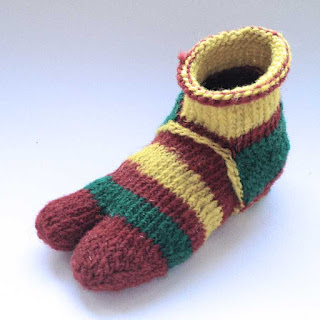
Unlike the tablet-woven bands , which were from the start intended to be displayed, my collection of replicas of knitted objects started as a serie of knitting experiments for reverse engineering or estimating how thin needles were needed for this or that gauge. Only later I added the objects knitted after patterns of other authors, to show the variability of knitting in the past. In chronological order: Child's woolen sock from Egypt (nowadays in the museum in Manchester ), 2nd century CE. Nalbound, not knitted! A similar (and more famous) sock is  in British museum , but I did not have the yarn in right colours for that one. :-) Child's cotton sock from Egypt  (nowadays in the Textile Museum in Washington DC) ,  12th-15th century CE. This replica is a result of many hours spent over the detailed photo, combined with  the pattern found on internet  - and  yet, halfway through my knitting I realized that the jog in my sock is on...

My private museum - Part 1: Tablet weaving

Image
I often demostrate tablet weaving at various historic events. After few years of talking to people about weaving and listening to their responses I realized that it is not enough to copy just the patterns to show the audience how skillful our ancestors were. Since then I try to use similar yarns to the original ones to show not only the complexity, but also the fineness of prehistoric and medieval weaving. In chronological order: Hallstatt (Austria), 800-400 BCE.  For my first attempt I used the finest wool I could find and I had to give up after few centimeters due to breaking threads. Therefore, I used cotton instead for my second attempt. Still, my band is 2 cm wide, while the original one was only 1.3 cm wide! Dürrnberg (Austria), 3th century BCE. Woven from the hand-spun and plant-dyed yarn for the book  Po nitkách do minulosti  ( Threads to the Past ). 29 tablets (triangular mostly), width: 1.8-2 cm. Lønne Hede (Denmark), 1st century CE.  Made as...

Introduction

After creating my web www.pleteni-tkani.cz I realized that some information presented there can be of some interest to my foreign friends who do not speak Czech. As I have a bad experience with automatic translations*, I decided to set up this copy of my blog with selected posts translated into English. Why only selected posts? Because the posts about local events in the Czech Republic are not of any use to foreigners, and other posts are intended for Czech people, who do not understand English, to get an access to the knowledge from English sources. Therefore, I will concentrate here only on my research projects in the field of knitting, tablet weaving and their history. * The worst and at the same time the funniest translation was probably tabby woven band with tablet woven edge = mourovatá bavlněná kapela s tabletem bavlněné hraně Explanation for non-Czech speaking people: "Tabby" was translated not as "tabby weave" but as "tabby cat", "band...