Posts

Showing posts with the label knitting

More stockings? Yes, please!

Image
My biggest research project so far has been an investigation of the stockings from the 16th and 17th centuries. However, my work did not end with the publishing of the article in Archaeological Textiles Review .  During CoVid lockdown, I managed to track down another pair of stockings, and as soon as the lockdown in our country ended, I went to see them. They belonged to Johann Sporck (?1595-1679), originally a German peasant, who joined the army at the beginning the Thirty Years War. He gradually rose in rank and shortly before the end of the war was ennobled. He died as the Count von Sporck and owner of rich estates in Bohemia. Kuks - the burial place of the Sporck family in Eastern Bohemia Unlike other stockings I have studied, his burial stockings were knitted from wool; not in as a fine gauge as silk stockings, but still quite fine: 50 loops (stitches) and 100 courses (rounds) per 10 cm. The legs of the stockings are similar to other stockings I have seen, but the fee...

My private museum - Part 3: Other knitted objects...

Image
...except socks and stockings . A sample of the wrist pattern from the so-called St. Adalbert's glove (probably 13th century). Knitted as a test, when I was trying to find out how thin needles were needed for a gauge 7-8 loops* per cm. (The answer: 0.75 mm (=US 000000)). The sample was intentionally left unfinished on the needle, for people who could not believe that such a fine knitting had been made by hand and not by machine. Two berets based on the find from Venetian ship wrecked in 1583 and the instructions published in  Textile Conservation and Research  by Mechtild Flury-Lemberg. The shape of the first one (grey), which was knitted exactly following the pattern, does not look right. In the brown beret I started increases already in the 2nd course and only then continued with increases in each 5th course, following the instructions, and it looks much better. Child's woollen mitten from  London , 16th century.  Based on the photo and dimesi...

My private museum - Part 2: Knitted socks and stockings

Image
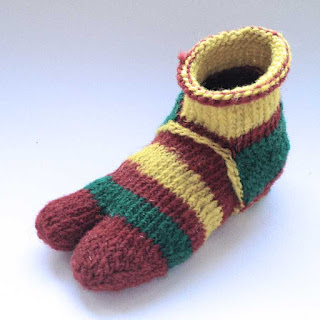
Unlike the tablet-woven bands , which were from the start intended to be displayed, my collection of replicas of knitted objects started as a serie of knitting experiments for reverse engineering or estimating how thin needles were needed for this or that gauge. Only later I added the objects knitted after patterns of other authors, to show the variability of knitting in the past. In chronological order: Child's woolen sock from Egypt (nowadays in the museum in Manchester ), 2nd century CE. Nalbound, not knitted! A similar (and more famous) sock is  in British museum , but I did not have the yarn in right colours for that one. :-) Child's cotton sock from Egypt  (nowadays in the Textile Museum in Washington DC) ,  12th-15th century CE. This replica is a result of many hours spent over the detailed photo, combined with  the pattern found on internet  - and  yet, halfway through my knitting I realized that the jog in my sock is on...